This paper explores the thought on extreme poverty and social justice of Father
Joseph Wresinski (1917–1988), a Catholic priest who devoted his life to working
with the very poor. To situate Wresinski within debates on social justice,
comparisons are made with John Rawls and Armataya Sen. The focus is on the
identification of the least advantaged and of who is responsible for
implementing social justice. For Rawls, the least advantaged can be defined
through their endowment of primary goods, and social justice is to be
implemented through a society’s core institutions. For Sen, the aim is to expand
capabilities, with a major role to be played by social institutions but also
with scope for individuals and communities to contribute. The call for building
alliances around the poorest in communities is strongest with Wresinski, for
whom extreme poverty is a violation of human rights that, together with social
exclusion, prevents the poor from fulfilling their responsibilities, leading to
a lack of self-worth as the ultimate deprivation.
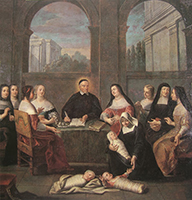
Alison Forrestal examines the role of laywomen of various social classes in
early Vincentian service. Although the concept of a lay vocation had not been
formulated in the seventeenth century, the service that laywomen, whether
married or single, provided to society rendered their state valuable and holy in
its own right. This was an important facet of the Catholic Reformation. Early
Vincentian efforts were innovative for the time, allowing women to organize and
perform the administrative work for their own service. Women also gave religious
instruction to the poor, which was unusual, and their own spirituality and
devotional activities were encouraged as a means of sustaining their endeavors.
Forrestal offers the female members of the Lamoignon family as a case study in
how laywomen saw themselves as called by God to participate in various forms of
charity. Although much of the development of the lay vocation came after their
time, Forrestal explains that these women “absorbed and applied newly emerged
spiritual and pastoral emphases on discernment, choice, and inclusivity. In
doing so, they were drawing the Catholic church a step closer to accepting what
they were first imagining and then bringing into being.”
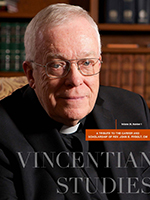
Distinguished scholar of the life and work of Elizabeth Ann Seton and longtime
member of the VSI Board, Sr. Betty Ann McNeil, D.C., provides a thoughtful and
heartfelt tribute dedicated to the accomplished career, scholarship, and immense
contributions made to Vincentian studies made by the Rev. John E. Rybolt, C.M.
An armchair said to have been used by Vincent de Paul may shed some light on his
early career. The chair has rods in its arms to support a board between them to
serve as a desk. It was donated to the Berceau in 2010 by a family from
Buzet-sur-Tarn, accompanied by a note that says that Vincent used this chair
during summers from about 1598 until 1604 while he tutored the sons of local
nobility and other students in the area. We still don’t know when or why he came
there, the level of his instruction, how long he stayed there, or what he
taught. However, this article makes some educated guesses to answer these
questions. John Rybolt believes it’s likely that Vincent was a tutor of basic
reading, writing, and arithmetic, rather than a teacher. Rybolt draws on what we
can learn from Vincent’s biographers and is able to make some connections to
what teaching or tutoring he might have done while pursuing his university
studies in Toulouse.
Vincent de Paul was an important reformer of the French Church, which faced
several problems with its clergy. Liturgical practices were not standardized,
and some priests lived corrupt lives. Because they received stipends for masses,
they often celebrated them for that reason rather than out of piety. They tried
to acquire several benefices (church offices) and dioceses at the same time to
profit from them all, although this was against canon law, and these were
sometimes essentially sold or hoarded by noble families. Church titles and their
accompanying incomes were also auctioned off by monasteries, and these, too,
were purchased by nobles. Worse, priests were “drunken and lewd,” without
vocation. To combat all this, Vincent founded the Congregation to be models of
priestly life, and he held the Tuesday Conferences, weekly periods of learning
and reflection for clergy. He also held retreats for them, and the Congregation
founded and directed seminaries to better train priests. Finally, he served on
the kingdom’s Council of Conscience, helping to ensure legitimate appointments
of bishops and abbots and working to combat Jansenism, which “exalt[ed] the
omnipotence of God at the expense of human freedom.”
This study presents the French text, English translation, historical context,
and a brief analysis of the speech given at Saint-Lazare on the civic
oath-taking in support of the 1790 revolutionary government in France, which
every adult citizen had to do publicly. At Saint-Lazare, a group of Vincentians
and their neighbors assembled in the motherhouse’s chapel for the oath. This
very rare and virtually unknown document is in Richardson Library’s special
collections at DePaul University in Chicago. Oath-taking was a way of replacing
royal legal authority before assemblies of citizens had been formed. By the time
of this oath on 7 February 1790, Saint-Lazare had already been sacked out of the
belief that it held grain supplies and ammunition. As one of the few remaining
usable spaces there, the chapel may have held about 250 people consisting of
three groups: the local Vincentian community, the soldiers stationed adjoining
the Saint-Lazare property, and some local (male) citizens. The fifteen-minute
speech was given by René-Pierre Devaudichon, the president of the local
district. An image gallery of the pages of the original document follows the
French text.
Three texts add to our knowledge of the work of Felix De Andreis (1778–1820),
the founding superior of the Congregation of the Mission in the United States.
These have recently come to light. Two are originals, and the third is a copy.
They are given in the original languages and in English, with introduction and
commentary. The first is an “Indian grammar” with the Lord’s Prayer and
catechism by Felix De Andreis, written circa 1817. According to David J. Costa,
a scholar in Native American linguistics, it “provide[s] us with the only source
of data that is clearly transitional between old Illinois and early Miami, but
also because it contains data from some Ojibwean dialect that does not match any
known present-day dialect.” The second discovery is an 1819 catechism written in
English by Felix De Andreis as lessons for atheists for use of priests working
in the United States. The third discovery is a single French sentence from a
letter from De Andreis that attests to the difficulties of living on the
American frontier.
Three letters from Francesco Cellini, a Vincentian novice, and his confrere,
Filippo Borgna, a Vincentian student with vows, are given or summarized here. In
1818, Cellini and Borgna made an eighty-eight-day voyage from Livorno, Italy, to
the United States. Cellini wrote an account to a friend in Rome, and Borgna
largely copied this in his letter, perhaps to ensure that one of their texts
would survive the trip back to Italy. These are the only known detailed records
of the Vincentians’ second journey to the US and reinforce records kept by Felix
De Andreis and Joseph Rosati, who came two years before. These accounts all
detail storms at sea and observe the US’s religious liberty and pluralism. The
Cellini letters discuss the beauty of American landscapes and nature. John
Rybolt adds, “Cellini’s emphasis on the saints as protectors and the devil as
the source of the problems during their journey is unique to his account.
Borgna’s letter adds valuable information on their travel arrangements after
arriving in the New World. Additionally, the accounts of the first and second
voyages clearly depict the challenges of reaching the new American mission on
its western frontier.” Biographical information about both Vincentians is
provided.
Louis William Valentine Dubourg, a priest of the Society of Saint Sulpice,
invited the Vincentians to establish a seminary for his diocese of Louisiana.
Part of his fundraising efforts to support these and other works was this
booklet, The Notice sur l’état actuel de la Mission de la Louisiane (Notice
Concerning the Current State of the Mission of Louisiana). Printed in 1820, it
circulated widely in Europe and was corrected, updated, and reprinted twice in
1822. Transcriptions given here illuminate differences between the editions. The
booklet’s author is anonymous but is probably Charles de la Croix, the bishop’s
secretary. The text, a narrative interspersed with passages from Dubourg’s
letters, describes the bishop’s journey to Louisiana, the condition of his
diocese, and the new mission’s construction. Other themes include North
America’s evangelization and civilization, particularly of Indigenous peoples,
illustrated with a woefully incorrect account of a Seneca chief’s acceptance of
Christianity. The corruption of civilization is also explored. Another theme is
that Protestants are good and could be successfully converted more easily in the
United States than anywhere else. Finally, the author explains “the perceived
importance of St. Louis as a center of commerce and Catholicism.”
This article explores poverty in New Orleans before Hurricane Katrina and the
factors which contributed to poor persons being the most affected by the storm.
Both the causes and results of poverty are investigated to see how they can be
alleviated as New Orleans recovers from Katrina. The Tulane/Canal neighborhood
is used as a case study for this. Faculty, staff, and students from the School
of Public Service and the Chaddick Institute of Metropolitan Development at
DePaul University were sent there to assist with recovery efforts in accordance
with the Vincentian mission. Their work is described and its effectiveness is
assessed. The demographics of New Orleans and the US definition of poverty are
also discussed.
Yvonne Pratt-Johnson defines poverty of spirit as “the wretched condition of
those whose pride and souls have been devastated by their material circumstances
or living conditions.” Even people who are not materially poor can feel
impoverished in spirit. She discusses her personal and professional Vincentian
response to this problem, which is to help restore dignity to those who may have
lost it. In her service to the elderly, she concentrates on being the kind of
listener that Vincent de Paul was. As a teacher of English to immigrant parents,
she treats her students as individuals and responds to them with respect and
empathy. As a professor, Pratt-Johnson strives to instill the same values in her
students, who are future teachers of English as a second language. She describes
the various ways in which she makes them more sensitive to the immigrant
experience and explains how Vincent de Paul influences and motivates her in this
endeavor.
The local Christian community had long held the Turkish site known today as
Mary’s House (Meryem Ana Evi) to be the historical Mary’s last residence and
final resting place. However, it was not until the Vincentians conducted an
archeological study of the first century ruins in 1891 that it became known to
the Church. Amelia Gallagher recounts the circumstances surrounding the
“discovery” of Mary’s House. She traces the location’s trajectory from a
Catholic shrine to one that is sacred to Catholics, other Christians, and
Muslims, particularly for pilgrims seeking healing from the springs there. She
explains differences in Christian and Muslim perspectives of and practices at
Mary’s House. The site is unique in Turkey because it is largely free of
regulations created by the Ministry of Religious Affairs to govern other Islamic
religious places. Gallagher also explores the meaning that Mary’s House has as a
tourist destination.
During the Industrial Revolution, poor persons constituted up to half the
population of Paris. They were considered to be criminal, and their poverty was
seen as a punishment for this. The Church believed the traditional social order
was divinely ordained. The rich were to be charitable and the poor were to be
resigned to their status; these conditions were necessary for the salvation of
both groups. In the Church’s eyes, the rich and the poor each contributed to the
gap between them, and they could only be reconciled by returning to Christian
values and the traditional social hierarchy. It was the Church’s responsibility
to guide this reconciliation. The Congregation, the Daughters of Charity, and
the Ladies of Charity, which had been dissolved during the Revolution, were
refounded under Jean-Baptiste Etienne in the nineteenth century. They tried to
combat poverty worldwide. As the first group of sisters to be supported by the
French government after the Revolution, the Daughters of Charity served as the
basis for the new Vincentian mission. The Ladies of Charity’s work, which was
under the Daughters’ direction, is discussed. The article also describes
Etienne’s view of the world and of the Vincentian mission in detail.
The complicated history of the establishment of Saint Katharine’s, a black
parish in New Orleans, is recounted. For reasons explained in the article, the
city’s Catholic churches were originally racially integrated. There were two
groups of blacks in New Orleans: colored Creoles (the term they used for
themselves) and African Americans. Colored Creoles were people of Afro-French
descent and they were Catholic. African Americans were Protestant and worshipped
in separate churches from whites. This was partly because of racism in the white
community and partly because African Americans wanted to control their own
religious affairs. Francis Janssens, the archbishop, wanted blacks to control
their churches and he wanted to win African American converts. Moreover, he
believed there were many defections among colored Creoles. He saw the solution
to all of this in Saint Katharine’s establishment, though he stressed that black
Catholics were free to choose between it and their home parishes. The colored
Creoles opposed segregation for any reason and therefore opposed Saint
Katharine’s. The negotiations for its establishment with the Vincentians and
with Katharine Drexel, who provided funds, are described in detail. Saint
Katharine’s was dedicated in 1895. With the advent of official segregation, it
became a successful parish.
This is an inventory of the archives of the Northeast Province of the Daughters
of Charity. It includes letters of Vincent de Paul; books and pamphlets by and
about him; letters of Louise de Marillac and documents pertaining to her; books
and pamphlets by and about her; letters of Elizabeth Ann Seton; books and
pamphlets about her; conferences and circulars of the superiors general; the
personal correspondence of Superior General William Slattery; books and other
materials on the Congregation’s saints, blessed, and notable others; histories
and annals of the Congregation; materials on the Vincentians in the United
States; items relating to the Daughters of Charity’s government; materials on
Catherine Laboure and other notable figures of the Daughters of charity;
circulars and other items, including books, by and about the superioresses;
books, pamphlets, etc. on the Daughters’ history; materials relating to early
superiors and superioresses in the United States; items related to the Northeast
Province’s government, history, and apostolates; and more.